PART ONE
The first time I died, my husband was standing ten yards away from me, signing his name as if he were closing a business deal.
I did not know that then, of course. At that moment, I was somewhere between the ceiling lights of St. Catherine’s Medical Center and a darkness so deep it seemed older than the world. I remember cold. I remember voices moving above me like birds in a storm. I remember someone shouting, “We’re losing her,” and another voice answering, “Not today. She has three babies waiting.”
Then there was nothing.
Hours earlier, I had been awake enough to hear my triplets cry.
Three tiny sounds, thin as thread, pierced the operating room one after another. First a girl, fierce and offended. Then another girl, softer, like a question. Then a boy, so small the nurse whispered, “Come on, little man,” before he finally announced himself with a cracked little wail.
I had smiled through the oxygen mask.
“Are they alive?” I had asked.
Dr. Mara Patel leaned close to me, her eyes shining over her surgical mask. “They’re alive, Lydia. All three of them are alive.”
I wanted to say their names. Bethany Rose. Nora June. Thomas Grant.
But the room tilted. The light bent. Someone pressed hard on my abdomen, and another nurse called for blood. I heard the machines change their tune. I remember trying to lift my hand, trying to point toward the bassinets, toward the three warm bundles being rushed across the room.
“Tell Grant,” I whispered.
No one heard me.
Or perhaps they did, but by then Grant Holloway had already made his choice.
My husband was a billionaire, though he disliked the word because it sounded vulgar when other people said it. He preferred “industrialist,” “investor,” “chairman,” or, when he was feeling sentimental, “builder.” He had inherited Holloway Capital at thirty-two and turned it into a machine that purchased companies the way some men purchased cufflinks. Everything around Grant was polished: the cars, the houses, the men who laughed at his jokes, the women who looked too long at his wedding ring.
When we married twelve years earlier, people said I had been chosen.
I was Lydia Bennett then, a librarian’s daughter from Ohio, raised in a little white house with lilac bushes, creaking floors, and Sunday pot roast after church. I was thirty-one, newly hired by the Holloway Foundation to help expand literacy programs for rural schools. Grant was forty, already famous, already rich, already impossible to ignore.
He could make a room turn toward him without speaking.
At first, I mistook that power for warmth.
He sent flowers to my office, asked about my mother’s arthritis, remembered that I took my coffee with cream but no sugar. He took me to restaurants where the menus had no prices and asked me about books as if my answers mattered. When he proposed six months later, he did it in the reading room of the old foundation library, beneath the portrait of his late mother, Margaret Holloway.
“She would have loved you,” he told me.
I believed him.
For many years, I believed many things.
I believed his coldness was stress. I believed his absences were business. I believed his impatience with my miscarriages was grief disguised as practicality. I believed that when he said, “Lydia, don’t be emotional,” he was asking me to be strong.
By the time I became pregnant with triplets at forty-three, after years of loss and one final round of IVF that left my body bruised and my heart terrified, Grant had become a man I studied more than I loved.
He bought three carved cribs from Italy but never touched my stomach.
He approved the nursery design but missed every ultrasound after twelve weeks.
He told reporters we were “blessed beyond measure,” then asked me privately whether three infants would make board travel “logistically impossible.”
Still, I hoped.
Hope is a foolish little bird, but when you are carrying three children beneath your ribs, you feed it crumbs every day.
The pregnancy was hard. By thirty-two weeks, my ankles were swollen, my blood pressure frightened the nurses, and I slept upright in a chair because lying down made it difficult to breathe. Grant moved into the guest suite “so I could rest.” His phone never stopped glowing.
Once, near midnight, I saw a message appear while he was showering.
Is she still pregnant?
No name, only initials: C.V.
When I asked him, he smiled, kissed my forehead, and said, “Corporate vultures. They circle when I’m distracted.”
I wanted to believe him. By then, belief was a habit I had not yet learned how to break.
The emergency came on a rainy Tuesday morning in March. I woke with a pain so sharp I thought the mattress had split beneath me. My blood pressure was dangerously high. The babies’ heartbeats dipped and fluttered. An ambulance took me through streets washed gray with rain while a young paramedic held my hand and told me to keep breathing.
Grant arrived forty minutes later in a navy suit, his hair perfect, his expression controlled.
“Is this necessary?” he asked Dr. Patel when she explained the emergency C-section.
Dr. Patel looked at him as if she had misheard. “Your wife and children could die.”
Grant adjusted his cuff. “Then do what you have to do.”
Those were the last words I heard him say before they wheeled me away.
Not “I love you.”
Not “I’m here.”
Not even my name.
After the babies came, after my body failed, after my heart stopped and the doctors began fighting to drag me back into the world, Grant stepped into the corridor outside the ICU and met his attorney.
The lawyer’s name was Simon Vale.
Later, I would learn that he was not only Grant’s attorney. He was Cassandra Vale’s older brother.
Cassandra was the woman behind the initials.
The attorney arrived with a leather folder tucked under one arm and a face pale enough to suggest even he had limits. A nurse named Anita told me months afterward that he kept looking toward the ICU doors.
“Mr. Holloway,” Simon said quietly, “your wife is critical. Are you certain you want to proceed right now?”
Grant did not cry. He did not ask whether I was in pain. He did not ask whether our children had ten fingers and ten toes.
He simply took the pen.
“How quickly can this be finalized?”
The hallway went silent.
Anita told me the question landed like a dropped tray.
Simon swallowed. “If the emergency petition is accepted, very quickly. Given the documents you prepared in advance, the court may process the preliminary dissolution today.”
“Good,” Grant said.
Dr. Patel came through the ICU doors minutes later, her surgical cap wrinkled, her mask hanging beneath her chin, her eyes red with exhaustion.
“Mr. Holloway, your wife is alive, but she is still critical. We may need authorization for additional procedures.”
Grant snapped the folder shut.
“I am no longer her husband.”
The doctor stared at him.
“As of two minutes ago, exactly,” he said, checking his watch. “Update the records.”
Then my husband walked away from the woman he had promised to cherish, from the three children who had arrived fighting for breath, and from the last decent chance God gave him.
At the elevator, his phone vibrated.
Cassandra Vale had written: Is it done?
Grant smiled.
Yes, he typed.
PART TWO
I woke three days later with a throat full of fire and a body that felt as if it had been broken into pieces and badly put back together.
The room was dim. Machines breathed and blinked around me. A nurse was adjusting a tube near my arm, humming softly under her breath. When she saw my eyes open, she froze.
“Lydia?” she whispered. “Can you hear me?”
I tried to speak. Nothing came out but a cracked sound.
Her face changed. She pressed a button and leaned close. “You’re safe. You’re in the ICU. Your babies are alive.”
My babies.
The words reached me before the pain did.
I began to cry without sound.
Dr. Patel came soon after. She touched my shoulder with a gentleness that nearly undid me.
“You scared us,” she said. “But you came back.”
I looked past her toward the door. My mouth formed one word.
Grant.
Her expression flickered.
It was small, almost invisible, but I saw it. Wives become experts at reading the space between words.
“He’s not here right now,” she said.
“Babies,” I rasped.
“They’re in the NICU. Small, but stronger than anyone expected. Bethany is bossing everyone around already. Nora likes to hold the nurse’s finger. Thomas is on oxygen, but improving.”
I closed my eyes. Their names existed. They were real. They had survived the terrible crossing.
For a few minutes, that was enough.
Then the world began returning in pieces.
A hospital administrator came that afternoon. Her name was Denise Arnold, and she wore a gray suit too stiff for a room where people were fighting to live. She stood beside my bed with a tablet in her hands and a pitying expression that made my stomach tighten.
“Mrs. Holloway,” she began, then corrected herself. “Ms. Bennett.”
I stared at her.
“Your legal surname has been updated in our system.”
My tongue felt thick. “What?”
She looked down. “Your marital status was changed while you were unconscious.”
Dr. Patel, standing near the window, turned sharply. “Denise.”
The administrator’s cheeks colored. “I’m sorry. This is a records issue, but it affects several authorizations.”
I tried to lift my hand. The IV line tugged. “Grant?”
Denise swallowed. “Mr. Holloway filed emergency dissolution documents.”
The words meant nothing at first. They lay on the blanket like foreign objects.
Dissolution.
Documents.
Filed.
“He divorced me?” I whispered.
No one answered quickly enough.
I laughed once, a dry, broken sound, because the truth was too large to enter any other way. I had gone into an operating room as a wife and come out as a problem he had solved.
“There’s more,” Denise said softly.
Of course there was. Cruelty rarely travels alone.
Because Grant had removed me from his private insurance plan, my coverage had been interrupted. Because my marital status had changed so suddenly, certain medical decisions had been flagged. Because the babies were born premature and their father had not signed updated responsibility forms, hospital legal had placed their discharge planning under review.
“My children,” I said. “You’re telling me I can’t see my children?”
“No,” Dr. Patel cut in, her voice firm. “No one is keeping you from your babies.”
Denise hesitated. “But formal access and guardianship paperwork need clarification.”
I had not thought a body so weak could hold so much rage.
“Clarification,” I repeated.
Denise lowered her eyes. “You are no longer listed as immediate family under Mr. Holloway’s household records.”
That was the sentence that changed me.
Not the divorce. Not the insurance. Not even the humiliation of waking to find my marriage erased like a clerical error.
It was the idea that Grant had tried to place distance between me and the three children I had nearly died bringing into the world.
For twelve years, I had trained myself not to raise my voice. I had become fluent in apology. I had learned to make his coldness comfortable, to explain his silences to others, to shrink my disappointment until it could fit inside a smile.
But lying in that ICU bed, stitched and swollen and half-alive, I felt something old and sturdy rise inside me.
It sounded like my mother.
Lydia, there comes a day when a woman has to stop asking why the snake bit her and start getting the poison out.
“Get me a phone,” I said.
Dr. Patel shook her head. “You need rest.”
“I need my children protected.”
The nurse, Anita, brought the phone.
I called Grant first.
He answered on the fourth ring.
“Lydia,” he said, not surprised, not relieved. Merely inconvenienced. “I was told you regained consciousness.”
“You divorced me while I was dying.”
A pause.
Then a sigh, as if I had opened with something tedious.
“This isn’t the time for dramatics.”
I could hear music behind him. Piano, maybe. Glasses clinking. He was somewhere elegant, somewhere expensive, somewhere untouched by blood.
“You took me off insurance.”
“My legal team handled the transition.”
“Our babies are in the NICU.”
“I’m aware.”
“You haven’t seen them.”
“I’ll visit when circumstances are less chaotic.”
I closed my eyes. “Grant, listen to yourself.”
“No, Lydia. You listen.” His voice hardened into the tone he used in boardrooms and restaurants when waiters displeased him. “This marriage has been functionally over for years. The pregnancy complicated timing, but it did not change reality. I made a practical decision.”
“A practical decision?”
“Yes.”
“I died.”
“You survived.”
The cruelty of that almost made me quiet.
Almost.
“You left me.”
“I removed myself from an unsustainable situation.”
“Our son is on oxygen. Our daughters weigh less than bags of flour.”
“I will meet my obligations as determined by counsel.”
There it was. Not fatherhood. Not love. Obligations.
“Was she worth it?” I asked.
Silence.
Then, coldly, “Goodbye, Lydia.”
He hung up.
For a long moment, I stared at the phone in my hand. I had thought hearing his voice would break me. Instead, it clarified something.
A marriage can die long before anyone signs papers.
Mine had died by inches, quietly, in guest rooms and missed appointments and questions answered by assistants. Grant had simply provided the death certificate.
That evening, after visiting hours, an elderly man in a camel-colored overcoat arrived at my ICU door. He had silver hair, a cane with a brass handle, and the kind of eyes that belonged to someone who had spent fifty years reading lies in fine print.
“Lydia Bennett?” he asked.
“Yes.”
“My name is Henry Wexler. I was Margaret Holloway’s personal attorney.”
Grant’s mother.
I had met Margaret only once before she died, a frail woman in a wheelchair with a velvet voice and sharp blue eyes. She had held my hand longer than expected and said, “My son understands money. I hope one day he understands mercy.”
At the time, I thought it was simply an old woman’s sadness.
Henry stepped inside.
“I need to ask you one question,” he said. “Did Grant Holloway voluntarily sign divorce documents while you were medically incapacitated following the birth of viable children?”
I stared at him.
Dr. Patel, who had entered behind him, folded her arms. “Yes. He did.”
Henry closed his eyes briefly.
Then he opened his leather briefcase.
“Then the countdown has begun.”
PART THREE
Henry Wexler did not speak like a man bringing revenge. He spoke like a man delivering weather.
Calmly. Precisely. As if the storm had been forming for years and he was merely the first person to mention the clouds.
“Margaret Holloway created several trust instruments before her death,” he explained the next morning, sitting beside my bed while rain tapped softly against the ICU window. “Most were ordinary. Charitable giving. Voting shares. Asset protection. But one was private.”
I was stronger that day, though not by much. A nurse had helped me sit upright. My incision burned. My hands trembled when I held water. But I was clear-headed enough to understand that Henry had not come for sympathy.
He had come because Grant had made a mistake.
“A private trust?” I asked.
Henry nodded. “The Holloway Maternal Protection Trust.”
I almost laughed. “That sounds like something from another century.”
“In many ways, Margaret belonged to another century. She was born in 1938. She remembered when banks would not give women credit cards without a husband’s signature. She remembered when pregnant wives were expected to endure anything quietly. She also remembered being abandoned.”
That caught me.
“By Grant’s father?”
Henry’s face softened. “Yes. Grant never told you?”
“Grant tells stories only when they flatter him.”
Henry looked toward the rain. “Margaret was pregnant with triplets when her husband, Arthur, left her for a woman in Palm Beach. He signed separation papers while she was hospitalized. Two of the babies died within a week. Grant was the only survivor.”
The room seemed to tilt.
“Grant was a triplet?”
“Yes.”
“He never told me.”
“Margaret said he hated the story. Not because it hurt him. Because it embarrassed him.”
I thought of my three babies under warm lights, fighting through tubes and wires. I thought of Grant checking his watch outside the ICU.
The son had become the father.
Henry removed a folder from his briefcase and placed it on the table.
“Margaret built Holloway Capital after Arthur left. Arthur’s family money opened doors, but Margaret’s mind built the empire. She never forgave herself for trusting a man who saw a wife’s suffering as an inconvenience. So when Grant became heir, she attached conditions.”
“What conditions?”
“Conduct conditions. Moral clauses. Protections for any spouse who bore or adopted children into the Holloway line.” He tapped the folder. “If Grant voluntarily abandoned, divorced, financially endangered, or medically neglected a spouse during pregnancy, childbirth, postpartum incapacity, or within one year of the birth of a child, a protective transfer would occur.”
I stared at him. “Transfer of what?”
“Voting control.”
I did not understand at first.
Henry continued. “Grant owns many assets outright. Homes, cars, personal accounts. But controlling interest in Holloway Capital was never his personal property. He has served as managing beneficiary. The trust held the voting shares.”
My mouth went dry. “And now?”
“Now those shares begin transferring to the protected spouse and the minor children, under independent trusteeship.”
I looked at the ceiling.
“You’re saying Grant divorced me and triggered his own removal?”
“I am saying Grant signed documents proving voluntary abandonment at the worst possible moment. He did it in a hospital corridor, in front of witnesses, after a physician informed him you might not survive. Then he demanded speed.”
“How fast can this be finalized,” I whispered.
Henry nodded. “That sentence will follow him for the rest of his life.”
I should have felt triumph.
Instead, I felt tired.
People imagine revenge as fire. They imagine it warming the blood, sharpening the spine, turning grief into victory. But real betrayal leaves ashes first. Before you can stand, you have to cough the smoke out of your lungs.
“What happens to my babies?” I asked.
“They will be protected. Medical care, housing, education, security. All of it. Immediately.”
“And me?”
“You are named provisional guardian of the children’s trust interests and beneficiary of the maternal protection provisions.”
I looked at him sharply. “Named by who?”
“Margaret.”
“She barely knew me.”
Henry smiled faintly. “She knew enough. You spent forty minutes with her in the foundation library. Do you remember?”
Of course I remembered. It had been two weeks before our wedding. Margaret, fragile under a cashmere blanket, had asked me why I loved books. I told her books had saved my life after my father died because they made the world feel larger than grief.
Margaret had squeezed my hand.
A woman who understands grief will recognize truth faster than a man who worships comfort, she had said.
Henry took a sealed envelope from the folder. My maiden name was written across it in Margaret’s wavering hand.
“This was to be delivered if the trust activated.”
My fingers shook as I opened it.
Dear Lydia,
If you are reading this, then my son has failed you in a way I prayed he would not.
Do not waste your strength wondering whether you could have loved him better. Some men receive devotion as proof that they deserve to take more. Grant was given everything except character, and character cannot be inherited.
I built safeguards not because I hated my son, but because I understood him.
If children have come into your care, protect them from the Holloway disease: the belief that money can excuse a hollow heart.
You are not powerless. You were never powerless. You were simply surrounded by people who benefited from you not knowing your own name carried weight.
Stand up when you can.
Until then, let the documents stand for you.
Margaret Eleanor Holloway
I read the letter twice.
By the third time, I was crying.
Not because Margaret had saved me, though she had. Not because Grant would be punished, though he would.
I cried because a woman I barely knew had seen me more clearly than the man who slept beside me for twelve years.
Two days later, Henry arranged for me to be wheeled into the NICU.
Nothing in my life had prepared me for how small they were.
Bethany Rose lay beneath a clear dome, one tiny fist raised as if preparing to argue with the world. Nora June slept with her mouth slightly open, impossibly delicate. Thomas Grant wore a knitted blue cap that slid over one ear.
I reached through the opening and touched each of them with one finger.
“Hello, my loves,” I whispered. “I’m sorry I’m late.”
A nurse smiled. “They knew you were coming.”
I stayed until my pain medicine wore thin and my body shook with exhaustion. Before they wheeled me back, I looked at Thomas. His middle name suddenly felt heavy.
“Can I change it?” I asked.
The nurse blinked. “His name?”
I nodded.
By evening, the paperwork was started.
Thomas Grant Holloway became Thomas Henry Bennett.
Not because Henry Wexler had saved us.
Because my father’s name had been Henry Bennett, and he had been a good man.
I wanted my son named after goodness.
PART FOUR
Grant called on the seventh day.
I had been moved out of ICU into a private recovery suite paid for, Henry informed me, by the trust Grant had accidentally awakened. Fresh flowers sat by the window. Not roses from Grant’s florist, but wildflowers from the nurses’ station, arranged in a plastic pitcher by Anita because “rich people flowers don’t smell like anything.”
My body was still weak, but my mind was returning to itself. Each day, I visited the NICU. Each day, I learned a new fact about my children. Bethany hated diaper changes. Nora calmed when someone hummed “Amazing Grace.” Thomas opened one eye whenever Henry Wexler spoke, as if already suspicious of attorneys.
The phone rang just after lunch.
Grant’s name appeared on the screen.
For one strange second, I felt the old reflex: straighten, soften, prepare to manage his mood.
Then I looked at the three tiny footprints taped to my wall.
I answered.
“We need to talk,” Grant said.
His voice had changed. The boardroom iron was still there, but underneath it ran something unfamiliar.
Fear.
“Do we?”
“Don’t be childish, Lydia.”
“There he is.”
A pause. “This situation has escalated unnecessarily.”
“Which situation? The one where I died, or the one where you divorced me before I woke up?”
“You know what I mean.”
“I know exactly what you mean. Your money moved.”
His breathing sharpened.
So it was true.
Henry had told me the first notices would go out quickly. Banks. Trustees. Corporate counsel. Board members. Grant would wake one morning and find that doors still opened, but not all the way.
“You have no idea what you’re interfering with,” he said.
“I’m recovering from major surgery and visiting three premature babies in the NICU. I’m not interfering with anything.”
“You activated a trust.”
“I was unconscious.”
“You called Wexler.”
“He came to me.”
Grant swore under his breath. In twelve years, he had rarely cursed around me. He considered it common. Hearing it now gave me a small, sad satisfaction.
“Listen carefully,” he said. “That trust is old, punitive, and vulnerable to challenge. I can tie it up for years.”
“Then why are you calling?”
Silence.
A nurse passed in the hallway, laughing softly with someone. The ordinary sound steadied me.
Grant lowered his voice. “We can fix this privately.”
“There is no we.”
“I will reinstate coverage. I will establish a generous settlement. You and the children will be comfortable.”
I almost smiled. “Comfortable.”
“Very comfortable.”
“You mean quiet.”
Another pause.
“Lydia, don’t turn this into a war.”
“You did that in the hallway.”
His voice hardened. “I made a decision under pressure.”
“No. Dr. Patel was under pressure. The nurses were under pressure. My babies were under pressure. You were holding a pen.”
He inhaled slowly. “Cassandra thinks—”
The name slipped out like a knife dropped on tile.
For the first time, he seemed to realize it.
“Cassandra,” I repeated.
“She has nothing to do with this.”
“Then she won’t mind being deposed.”
That was Henry’s line. I borrowed it with pleasure.
Grant hung up.
The next time I saw him was eleven days after the birth, through the glass of the NICU.
He arrived wearing a charcoal suit and the expression of a man visiting an underperforming asset. Cassandra Vale stood beside him.
She was younger than me by perhaps twelve years, though not young enough to mistake cruelty for sophistication. She had honey-blond hair, a cream coat, and a diamond necklace that caught the hospital lights. Her hand rested lightly on Grant’s sleeve, announcing possession.
I was seated beside Nora’s incubator, humming softly.
Grant stopped when he saw me.
For a moment, no one spoke.
Then Cassandra smiled.
“Lydia,” she said. “I’m so glad you’re recovering.”
There are women who can make kindness sound like a receipt.
I looked at Grant. “You brought her here?”
Cassandra’s smile tightened. “I thought it might help if we all behaved like adults.”
A nurse nearby lifted her head. Dr. Patel, standing at the far counter, went still.
I stood slowly, one hand on the chair for balance. Pain flashed white through my abdomen, but I remained upright.
“Adults,” I said. “Is that what you call people who wait outside an ICU for a signature?”
Grant’s jaw clenched. “Cassandra came to support me.”
“No,” Dr. Patel said sharply.
Everyone turned.
She stepped forward, her voice cold. “Support is what we were doing when your wife had no heartbeat. Support is what the NICU staff does when your son forgets to breathe. Do not use that word in here.”
Cassandra flushed.
Grant’s eyes narrowed. “Doctor, I would be careful.”
Dr. Patel did not blink. “Mr. Holloway, I have been awake for thirty hours keeping children alive. I am exactly as careful as I need to be.”
That was the first time I saw Grant lose control in public.
Not completely. Just a crack. A twitch near his eye. A tightening of his mouth. But I knew him well enough to understand what it meant.
He was discovering that money could buy privacy, service, silence, and beautiful rooms.
It could not buy reverence from a woman who had watched him abandon his newborn son.
Henry filed the first petition that afternoon.
Within a week, Grant was temporarily suspended from voting the trust-held shares. Holloway Capital’s board announced an emergency review. News of the divorce leaked, then the hallway story followed, then the quote.
How quickly can this be finalized?
By then, Grant’s polished world began to dull.
A children’s hospital canceled his keynote speech. A university returned his donation. The family office froze discretionary transfers pending fiduciary review. Shareholders demanded answers. Cassandra disappeared from public photographs.
Grant, who had spent his life arranging people like furniture, found himself standing in rooms where no one knew where to put him.
He tried anger first.
Then charm.
Then memory.
One evening, just before sunset, he came to my room alone. No lawyers. No Cassandra. No cameras.
He looked tired.
For a foolish second, I saw the man from the library. The man who had asked about my favorite novel. The man I had loved before I understood that charm could be a costume.
“Lydia,” he said quietly. “I made mistakes.”
“Yes.”
“I panicked.”
“No, Grant. Panic looks messy. You were neat.”
He winced.
I should not have cared, but some old part of me did. Love does not vanish cleanly. It leaves roots. Even when you pull it out, dirt clings.
“I never wanted children this way,” he admitted.
“This way?”
“Three at once. The medical risks. The chaos. The exposure.”
“They’re not exposure. They’re babies.”
“I know that.”
“No, you don’t.”
He walked to the window. The city below was turning gold in the evening light.
“My mother ruined my father,” he said.
“Your father abandoned her.”
“She took everything.”
“She built everything.”
He turned, eyes sharp. “Is that what Wexler told you?”
“It’s what the documents show.”
His laugh was bitter. “Documents. My whole life, she controlled me with documents.”
“And you tried to erase me with them.”
That silenced him.
For the first time since I had known him, Grant looked old. Not mature. Not wise. Just old in the way selfish people become old when consequences finally find them.
“I want to see them,” he said.
I looked toward the NICU wing beyond the hall.
“Why?”
“They’re my children.”
“Are they?”
His face hardened. “Don’t be cruel.”
The irony almost took my breath.
“I’m asking seriously. Are they your children in your heart, or only in court?”
He had no answer.
So I gave him one.
“When they are stronger, when the doctors approve, and when a court agrees on safeguards, you may see them. But you will never again use access to them as leverage over me.”
“You can’t keep them from me.”
“I’m not. I’m protecting them from the man you were when they needed you most.”
He stepped closer. “And if I become better?”
The question surprised me.
So did my answer.
“Then become better where no one is applauding.”
PART FIVE
The hearing took place six weeks after the birth in a wood-paneled courtroom that smelled faintly of furniture polish and winter coats.
By then, I could walk without holding the wall. Bethany, Nora, and Thomas were still small, but all three were breathing on their own. The nurses had begun speaking of discharge in hopeful tones. I had learned to change diapers through incubator portholes, to read oxygen monitors, to sleep in ninety-minute fragments, and to love with a ferocity that frightened me.
Grant arrived with a legal team large enough to defend a nation.
Cassandra did not sit beside him.
I noticed that immediately.
Henry sat to my right, calm as a church elder. Dr. Patel sat behind me. Anita had come on her day off. Denise Arnold, the hospital administrator, had been subpoenaed and looked as if she wished she had chosen a simpler profession.
The judge was a woman in her sixties named Honora Bell, with silver hair and half-moon glasses. She read the filings without expression. Then she looked over the top of her glasses at Grant.
“Mr. Holloway, did you sign emergency dissolution documents while your wife was unconscious following childbirth?”
Grant’s attorney rose. “Your Honor, the characterization—”
Judge Bell raised one finger.
The attorney sat.
Grant’s throat moved. “Yes, Your Honor.”
“Were you informed she might not survive?”
“I was informed there were complications.”
Dr. Patel leaned forward. Henry placed a hand gently on my wrist.
The judge looked down. “The record includes testimony that you were told she was alive but critical and that authorization might be needed for additional treatment.”
Grant said nothing.
“Did you respond, ‘I am no longer her husband’?”
His face darkened.
“Yes.”
“Did you ask how quickly the divorce could be finalized?”
Grant’s attorney closed his eyes.
“Yes,” Grant said.
There it was. The truth, stripped of tailoring.
Henry stood next.
He did not thunder. He simply walked the court through the trust, clause by clause. Margaret Holloway’s history. Arthur Holloway’s abandonment. The birth of triplets. The deaths of two infants. Grant’s conditional inheritance. The maternal protection provisions.
Then Henry presented the final document.
A codicil Margaret had signed three months before her death.
“If a protected event occurs,” Henry read, “and if the abandoned spouse survives, she shall be offered not only financial protection, but stewardship authority over the Holloway Family Foundation and voting oversight of all child-beneficiary interests until the youngest child reaches twenty-five.”
Grant went white.
I turned to Henry. He had not told me that part.
Henry whispered, “Margaret wanted you to hear it when he did.”
Grant stood abruptly. “This is absurd.”
Judge Bell’s gaze sharpened. “Sit down, Mr. Holloway.”
But Grant was staring at Henry.
“She couldn’t do this.”
“She did,” Henry said.
“She was punishing me for my father.”
“No,” Henry replied. “She was protecting your children from becoming him.”
The courtroom was silent.
Then the doors opened.
Cassandra Vale walked in.
For one heartbeat, I thought she had come to rescue him. Grant seemed to think so too, because his face filled with desperate relief.
“Cass,” he said.
She did not look at him.
She walked to the front with a folder clutched in both hands and took the witness seat.
Grant’s relief curdled into alarm.
Henry leaned toward me. “Here comes the part even Margaret didn’t plan.”
Cassandra testified for forty-three minutes.
She admitted that Grant had begun planning the divorce months before the birth. She admitted he had asked Simon Vale to prepare filings that would protect him from “medical liabilities” if I survived and preserve inheritance options if I did not. She admitted Grant had promised to marry her once the “family optics” were contained.
Then she opened the folder.
“These are messages,” she said, voice trembling. “He told me if Lydia died, grief would be useful. If she lived, speed would be useful.”
A sound moved through the courtroom. Not quite a gasp. More like every decent person present inhaling at once.
Grant stared at her as if she had become a stranger.
“Why?” he whispered.
Cassandra finally looked at him.
“Because you were going to do the same thing to me.”
His mouth opened.
She placed one hand over her abdomen.
“I’m pregnant.”
The courtroom erupted.
Judge Bell struck the gavel. “Order.”
Cassandra’s voice broke, but she kept speaking.
“When the news broke, Grant told me not to worry. He said Simon could prepare documents limiting my claims too. He said he had learned from his mistake with Lydia.” She looked at me then, and for the first time there was no polish in her face, only fear. “I’m sorry. I thought I had won something. But I had only stepped into the same cage.”
Grant sank slowly into his chair.
That was the twist none of us had seen coming.
Not that Grant had betrayed me. I knew that.
Not that Cassandra had helped him. I knew that too.
The true horror was that Grant had not abandoned me because he stopped loving me.
He abandoned me because abandonment was his pattern. His inheritance. His language. The only thing he knew how to do when love required sacrifice was reach for a pen.
Judge Bell’s ruling was not dramatic. Real justice rarely is. It came in measured sentences, legal findings, temporary orders, trustee confirmations, custody protections, medical responsibilities, and referrals for financial investigation.
But every word was another stone removed from my chest.
Grant lost voting control pending full trust execution.
I was confirmed as provisional steward of the Holloway Family Foundation.
The children’s medical care was secured.
The divorce he had rushed became the instrument that exposed him.
When it was over, Grant remained seated after everyone else stood. His attorneys gathered papers around him like men cleaning up after a fire. Cassandra left through a side door. Henry offered me his arm.
At the back of the courtroom, Grant called my name.
“Lydia.”
I turned.
For the first time since I had known him, he had nothing to offer. No check. No threat. No polished explanation.
Only emptiness.
“Did you ever love me?” he asked.
The question hurt because the answer was still yes.
“Yes,” I said. “I loved the man I thought you were. And I grieved him long before you signed those papers.”
His eyes glistened. Whether from sorrow or self-pity, I could not tell.
“And now?”
I thought of Bethany’s raised fist. Nora’s tiny mouth. Thomas opening one suspicious eye at Henry’s voice. I thought of Margaret Holloway, young and abandoned with three infants, building an empire because grief had given her no softer option. I thought of my mother’s lilacs and my father’s patient hands repairing the porch steps every spring.
“Now,” I said, “I love them more than I miss you.”
Seven months later, I brought the triplets home.
Not to Grant’s glass mansion, but to Margaret Holloway’s old estate in Connecticut, a sprawling stone house with ivy on the walls, books in every room, and sunlight that fell through tall windows like blessing. The trust had maintained it for years, waiting for a family that deserved more than display.
Bethany came home first, loud and furious at the indignity of car seats.
Nora came home second, blinking at the world as if deciding whether to forgive it.
Thomas came home last, wrapped in a blue blanket knitted by Anita, who cried so hard she had to sit down on the porch.
Henry visited every Sunday. Dr. Patel came for the christening. Denise Arnold sent a handwritten apology and three silver baby spoons. Cassandra, through her attorney, sent a letter I did not read for two weeks. When I finally opened it, it contained only five words.
I understand now. I’m sorry.
I placed it in a drawer. Forgiveness, I had learned, should never be rushed to make the guilty comfortable.
Grant saw the children under supervised arrangements at first. He arrived stiff and pale, as if fatherhood were a country where he did not speak the language. Bethany cried whenever he held her. Nora studied him gravely. Thomas once grabbed his tie and would not let go, making Henry mutter, “Good boy.”
Over time, Grant changed in small ways that may or may not have been real. He stopped bringing gifts. He learned how to warm bottles. He sat on the floor in expensive trousers while Bethany beat a wooden spoon against his shoe. He never apologized well, but one afternoon, while Thomas slept against his chest, he whispered, “I don’t know how to be different.”
I was standing in the doorway.
“Then learn,” I said.
He looked up. “Will it matter?”
I thought about that.
“To them, maybe. To me, not the way you want.”
He nodded as if the answer cost him something.
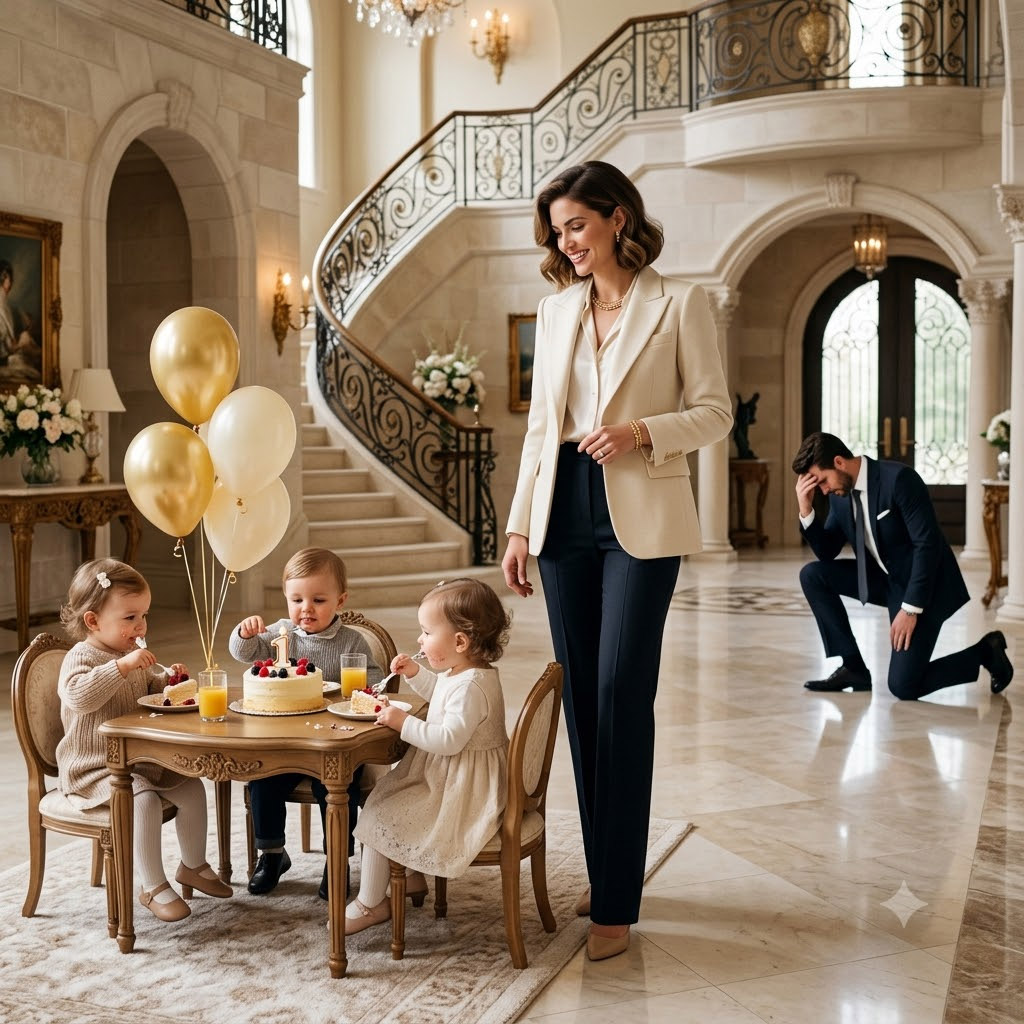
The final surprise came on the triplets’ first birthday.
Henry brought Margaret’s last sealed envelope. This one was addressed not to me, but to the children.
“To be opened,” Henry read, smiling, “when the first birthday cake has been thoroughly destroyed.”
Bethany handled that requirement with enthusiasm.
After cake, after photographs, after Nora fell asleep with frosting in her hair, Henry opened the envelope. Inside was a single page and a small black-and-white photograph.
The photograph showed a young Margaret Holloway in a hospital bed, pale and fierce, holding one infant. Beside her were two empty bassinets.
On the back, in her handwriting, were three names.
Samuel. Eleanor. Grant.
Henry’s voice grew rough as he read the letter.
My dear children,
If you are hearing this, then life has done what life does best: it has continued.
You come from a family with money, but do not mistake money for inheritance. Your true inheritance is the chance to become better than those who came before you.
Your father was once a tiny boy in my arms, the only one of three who stayed. I loved him with a wounded heart, and wounded love can sometimes spoil what it means to save. If he has failed you, let that failure end with him.
Lydia, if you are the one reading over their shoulders someday, tell them this: I chose you not because you were perfect, but because you knew books, grief, and kindness. A woman who has survived all three can rebuild almost anything.
The room blurred.
Henry folded the letter carefully.
Grant, who had been allowed to attend the birthday under Henry’s watchful eye, stood near the window. His face had gone ashen.
“All my life,” he whispered, “I thought she made that trust because she hated my father.”
Henry looked at him with something like pity.
“No, Grant. She made it because she was afraid she had raised you to become him.”
No one spoke.
Then Bethany, sitting in her high chair, slammed both frosting-covered hands onto the tray and shrieked with delight.
The sound broke the spell.
Nora woke and began to cry. Thomas laughed because Bethany was laughing. Life, as Margaret had written, continued.
I looked at my children, at their messy faces and bright eyes, and understood the final truth.
Grant had signed divorce papers believing he was ending a burden.
Instead, he had signed the confession that freed us.
He thought he was removing me from his life.
Instead, he removed himself from the center of mine.
And the empire he had spent decades building did not collapse because I attacked it.
It collapsed because, hidden deep in its foundation, a woman who had once been abandoned had left a door unlocked for another woman to walk out.
So I walked.
Not alone.
Never again alone.
I walked with Bethany Rose in my arms, Nora June against my shoulder, and Thomas Henry sleeping against my heart.
Behind us stood the ruins of Grant Holloway’s certainty.
Ahead of us waited a life he could not buy, control, erase, or finalize.
And for the first time since the operating room lights went dark, I was not coming back from death.
I was coming back to myself.