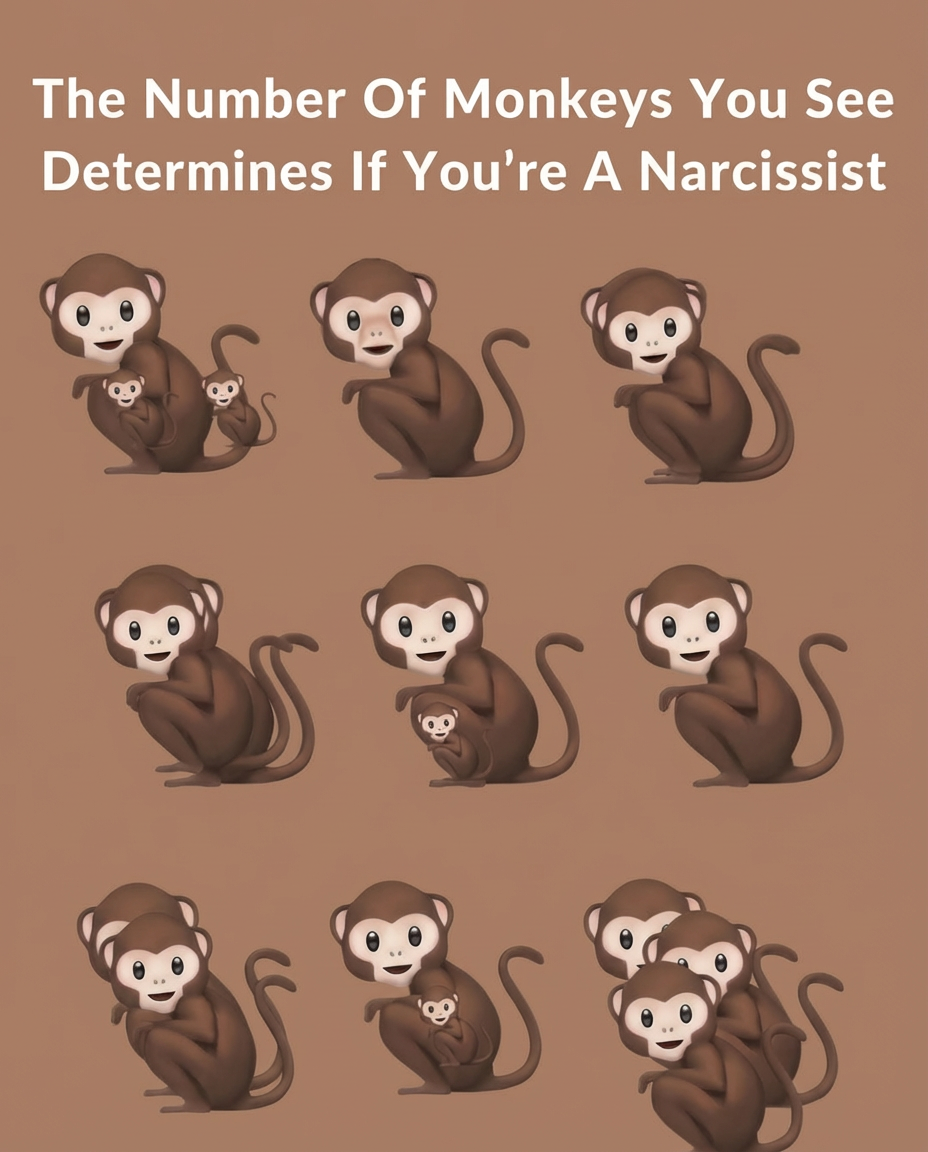
You’ve seen it: a grid of cartoon monkeys paired with a bold headline—“The number you see determines if you’re a narcissist.”
Your eyes scan. You count. A flicker of curiosity—or quiet concern—rises. Did I miss something? What does this say about me?
This isn’t accidental. The image is engineered to captivate. But the truth beneath the clickbait is far more meaningful—and far kinder—than the headline suggests.
First, the Essential Clarification
There is no scientific link between counting monkeys and narcissism.
None. Zero.
Narcissistic Personality Disorder is a complex clinical condition diagnosed through comprehensive psychological evaluation—not a visual puzzle. This claim is classic viral psychology bait: provocative language designed to trigger shares, comments, and anxiety.
Let’s gently set that aside.
Because what is real—and deeply human—is the quiet magic of perception itself.
Why Do We See Different Numbers?
When you look at the image, your brain isn’t passively recording pixels. It’s actively constructing meaning—filtering, prioritizing, and filling gaps based on:
→ Attentional style: Do you gravitate toward the obvious whole, or naturally hunt for hidden details?
→ Cognitive wiring: Some brains emphasize global patterns; others delight in nuanced textures.
→ Life experience: Past encounters with optical illusions, art, or even stress shape what your eyes prioritize.
→ The moment you’re in: Fatigue, distraction, or calm presence shifts your perceptual lens.
One person sees seven clear monkeys. Another notices tiny figures woven into negative space, subtle overlaps, or clever repetitions. Neither is “right.” Neither is “wrong.”
They are simply different ways of seeing.
What This Gently Reflects (Without Judgment)
While this illusion reveals nothing about narcissism, it can offer a mirror to your perceptual tendencies:
If you noticed…
It may reflect…
Primarily the obvious monkeys
A strength in big-picture clarity—efficiently grasping the whole without getting lost in fragments.
Hidden layers and subtle details
A natural attunement to nuance—a mind that lingers, observes, and discovers what others overlook.
These are neutral traits. Neither is superior. A teacher noticing a child’s quiet struggle needs detail-orientation. A leader guiding a team through change needs big-picture vision. Both are gifts.
Why These Illusions Captivate Us
Three deeply human instincts fuel their spread:
Curiosity – “What did I miss?” invites us to look deeper.
Self-reflection – We’re drawn to gentle mirrors that help us understand our own minds.
Connection – Sharing “I saw 9!” sparks conversation, bridges differences, and reminds us: We see the world through unique eyes.
These images transform a simple graphic into a shared moment of wonder—a quiet celebration of cognitive diversity.
The True Invitation
The monkeys were never the point.
The real gift lies in the pause this creates—the gentle nudge to ask:
→ How do I see the world?
→ Could someone else perceive this differently—and what might I learn from that?
→ Where else in life do I assume my view is the only view?
This isn’t about counting correctly.
It’s about cultivating humility.
Empathy.
Curiosity.
It’s the quiet realization that two people can stand before the same image—
and inhabit entirely different worlds of meaning.
And both are valid.
So look again.
Not to prove anything about yourself.
Not to judge your perception.
But to marvel at the quiet miracle of how your mind meets the world.
How many monkeys do you see now?
And more importantly—
What does that gentle difference teach you about seeing others?
P.S. Share what you noticed—not as a score, but as a story. What did your eyes find first? In that sharing lies connection.